
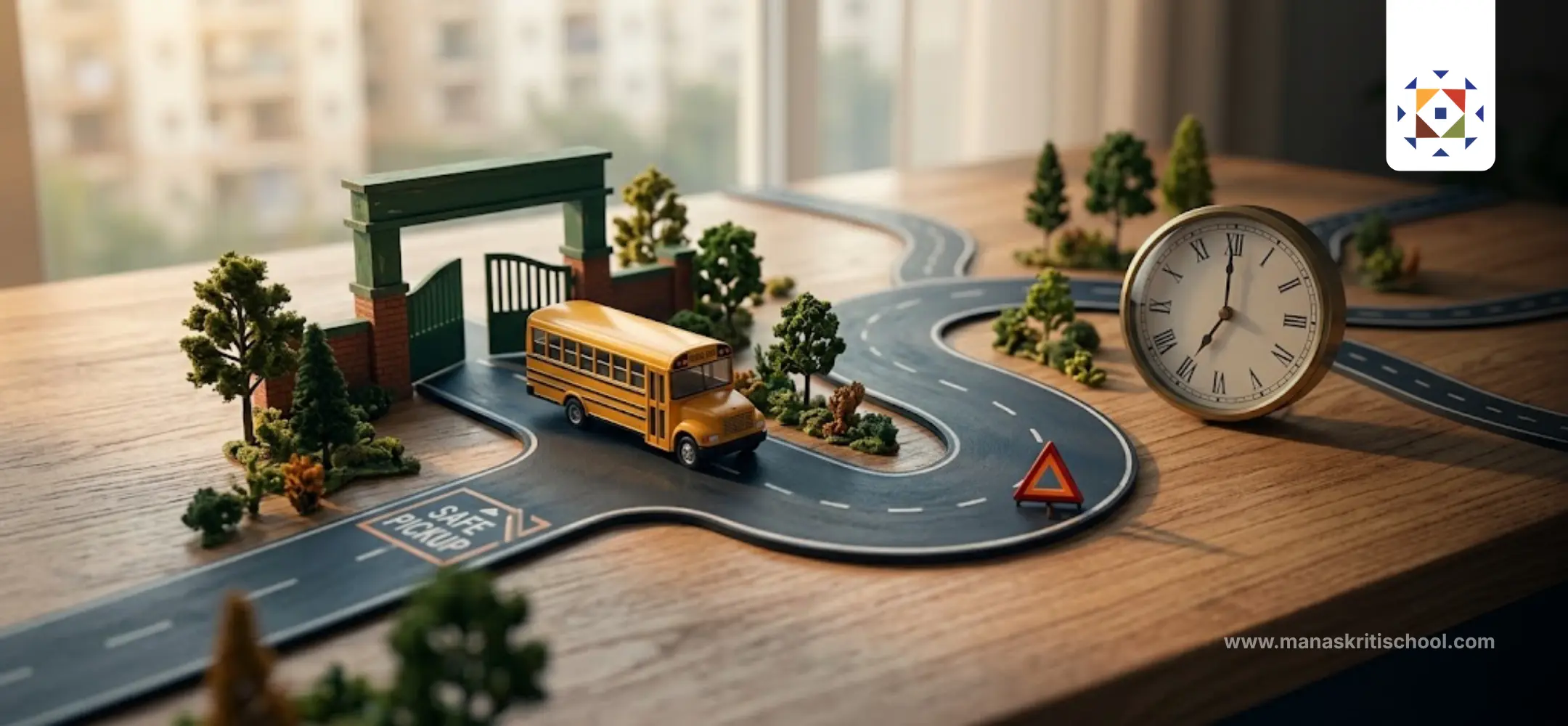
Parents comparing school transport in Greater Faridabad should verify the exact pickup point, real door-to-door travel time, vehicle and staff safety checks, student handover, attendance procedure, emergency communication, route-change rules, seat availability and complete transport fee. A short distance on a map does not guarantee a short, predictable or available school-bus route.
Transport shapes every school day. A child may spend more time travelling than a family first expects, especially when a route includes several stops or meets busy traffic. The best test is not the route on a quiet weekend. It is whether the journey remains safe, manageable and sustainable during an ordinary school morning and afternoon.
This guide is published by Manaskriti School in Sector 82, Greater Faridabad. Use it to ask the same questions at every shortlisted school.
Quick answer: A suitable school route has a confirmed stop and seat, clear adult responsibility, reliable attendance and handover, an understood emergency process, and a travel time your child can manage without losing healthy sleep, meals, play or study time.
Why is school distance different from school travel time?
Map distance measures kilometres between two points. A school-bus journey may include travel from home to the stop, waiting, multiple pickups, a planned route, gate entry and the final handover. Traffic, road conditions, construction, weather and school timings can also affect the experience.
| Part of the journey | What parents should measure | Question to ask |
|---|---|---|
| Home to pickup point | Walking or driving time and safe waiting space | Can the child reach the stop safely every day? |
| Waiting | Expected arrival window and adult supervision | What happens when the bus is early or delayed? |
| Bus route | Normal duration, number of stops and likely variation | Is the estimate based on the planned route? |
| School arrival | Gate-to-class transition and supervision | Who receives children after they leave the bus? |
| Afternoon handover | Departure, drop sequence and authorised adult handover | What happens if the receiving adult is absent? |
Test the road journey at approximately the real school time. Then ask the transport team for the route estimate. The two measurements answer different questions: your test shows traffic conditions, while the school estimate should include the actual stop sequence.
How long should a child’s school commute be?
There is no single ideal number of minutes for every child. Age, temperament, route predictability, pickup time, supervision, motion sensitivity and the family’s daily routine all matter. A duration that one older student manages comfortably may exhaust a young child.
Instead of choosing an arbitrary maximum, protect these everyday needs:
- Age-appropriate sleep and a calm waking time
- Enough time for breakfast and preparation
- A safe and supervised wait
- Reasonable arrival before the school day begins
- Time after school for food, rest, movement and family
- A routine the household can sustain five days a week
Run a one-week paper simulation. Write down the required waking time, departure, estimated pickup, school arrival, return and bedtime. If the routine works only when every road is empty and every family member is perfectly punctual, it needs a more realistic buffer.
What should parents check about school-bus safety?
CBSE’s transport-safety guidance and wider school-safety guidance treat transport as a serious institutional responsibility. Parents do not need to conduct a mechanical inspection themselves, but they should ask the school how compliance, maintenance, staffing, supervision and records are managed.
Vehicle and legal readiness
- Who owns or operates the vehicle?
- How are permits, insurance, fitness and maintenance tracked?
- How does the school ensure the vehicle does not exceed permitted capacity?
- What safety and first-aid equipment is carried?
- How are breakdowns handled without leaving students unsupervised?
Driver, attendant and adult responsibility
- How are drivers and attendants selected and verified?
- Who is responsible for children during boarding, travel and deboarding?
- How are staff trained for behaviour, first aid and emergencies?
- Who checks the vehicle after the final child leaves?
- How can a parent report a transport concern?
Attendance and student handover
- How is each boarding and deboarding recorded?
- How is an absent child distinguished from a missed pickup?
- Who may receive a younger child at the stop?
- What happens if the authorised adult is not present?
- How is a temporary change in pickup or drop authorised?
Communication and emergencies
- Which channel communicates a delay or route disruption?
- Whom should parents contact during the journey?
- What happens after a medical concern, breakdown or traffic closure?
- How are emergency contacts kept current?
- When and how is the school leadership informed?
What should parents observe at the pickup point?
Visit the proposed point at the expected time. Look at traffic speed, lighting, road crossing, standing space, waterlogging, construction, stray animals and whether a child can wait without blocking a driveway or entering the road. Ask whether the stop is fixed and whether it can change when the route is finalised.
For a younger child, decide which adult will accompany and receive the child every day. Create a backup plan for illness, work travel and unexpected delay. The safest written school procedure cannot replace the family’s own reliable handover arrangement.
How should families evaluate route communication?
| Situation | Information needed | Family action |
|---|---|---|
| Routine delay | Notification channel and revised estimate | Keep the authorised receiver available |
| Child absent | Whether and when absence must be reported | Use the official channel, not an informal message |
| Different receiver | Identity and authorisation procedure | Complete approval before the route begins |
| Temporary address change | Whether route changes are allowed | Do not assume the bus can make an extra stop |
| Emergency | Escalation, care and parent-contact sequence | Keep all emergency numbers current |
A tracking feature can be helpful, but it does not replace attendance, supervision, staff training or a reliable emergency process. Ask what happens when connectivity or the tracking service is unavailable.
How should parents compare school transport fees?
Ask whether the fee depends on distance, route or stop, and confirm its billing period. Also ask about one-way use, mid-session joining, withdrawal, route changes, holidays and refunds. A fee quote should not be treated as route confirmation.
As checked on 15 September 2026, Manaskriti’s official 2027-28 fee page publishes five transport distance slabs:
| Distance slab | Published amount | What must still be confirmed |
|---|---|---|
| 0 to 2 km | ₹1,700 | Billing period, route, stop and seat |
| 2 to 5 km | ₹3,000 | Billing period, route, stop and seat |
| 5 to 10 km | ₹3,500 | Billing period, route, stop and seat |
| 10 to 15 km | ₹4,500 | Billing period, route, stop and seat |
| 15 to 20 km | ₹5,500 | Billing period, route, stop and seat |
The official page states that final allocation is subject to route planning, seat availability and the confirmed pickup location. Families should ask the admissions or transport team to confirm the amount’s billing frequency before calculating the annual cost.
What if the school bus does not serve the address?
Compare alternatives carefully: family drop-off, carpooling, a private vehicle or another school with a workable route. Clarify the school’s gate, identity and handover rules for each option. A private van should not be assumed to follow the school’s transport controls merely because it carries students from that school.
Any informal arrangement requires its own checks concerning the vehicle, driver, capacity, supervision, insurance, emergency communication and authorised handover. Do not select an unsafe daily arrangement only to preserve a preferred school choice.
What transport questions should parents ask during a school visit?
- Does a current route serve our exact address or a nearby confirmed point?
- Is a seat currently available for the child’s grade and timing?
- What are the estimated pickup, school-arrival and drop times?
- How many stops are normally before and after ours?
- How are boarding, deboarding and final vehicle checks recorded?
- Which adults travel on or supervise the vehicle?
- How are drivers, attendants, vehicles and documents verified?
- What happens when a receiver is absent or unauthorised?
- How are delays, breakdowns and emergencies communicated?
- What fee, billing period, withdrawal rule and route-change condition apply?
Bring the wider school-visit question list so transport remains part of the full school decision rather than the only factor.
Frequently asked questions about school transport
Does living within a fee slab guarantee a school-bus route?
No. A distance slab is a pricing framework, not a promise that a route, stop or seat exists. Obtain confirmation for the exact location.
Is the nearest school always the easiest commute?
No. Road access, stop sequence, traffic and the pickup arrangement can make a farther school more predictable or a nearby one less practical. Test the real journey.
Should a very young child use school transport?
The decision depends on travel time, supervision, handover, the child’s comfort and the family’s routine. Ask how the school supports younger children and observe the proposed stop.
Is live GPS enough to make a route safe?
No. Tracking can support communication, but safe transport also needs suitable vehicles, verified adults, attendance, supervision, handover, maintenance and an emergency process.
How can we ask Manaskriti about our route?
Contact the school with the exact pickup location and child’s grade. Confirm route feasibility, stop, travel estimate, seat and current fee before paying or organising the family’s routine.
Choose the route your family can sustain every day
A school commute should work on an ordinary Tuesday, not only during a quiet trial. Verify the entire journey, understand adult responsibility, test the handover plan, read the fee terms and protect the child’s daily routine. If the route cannot be confirmed safely and practically, treat that as important decision evidence.
Families considering Manaskriti can book a campus visit and discuss the exact address with the admissions or transport team.