
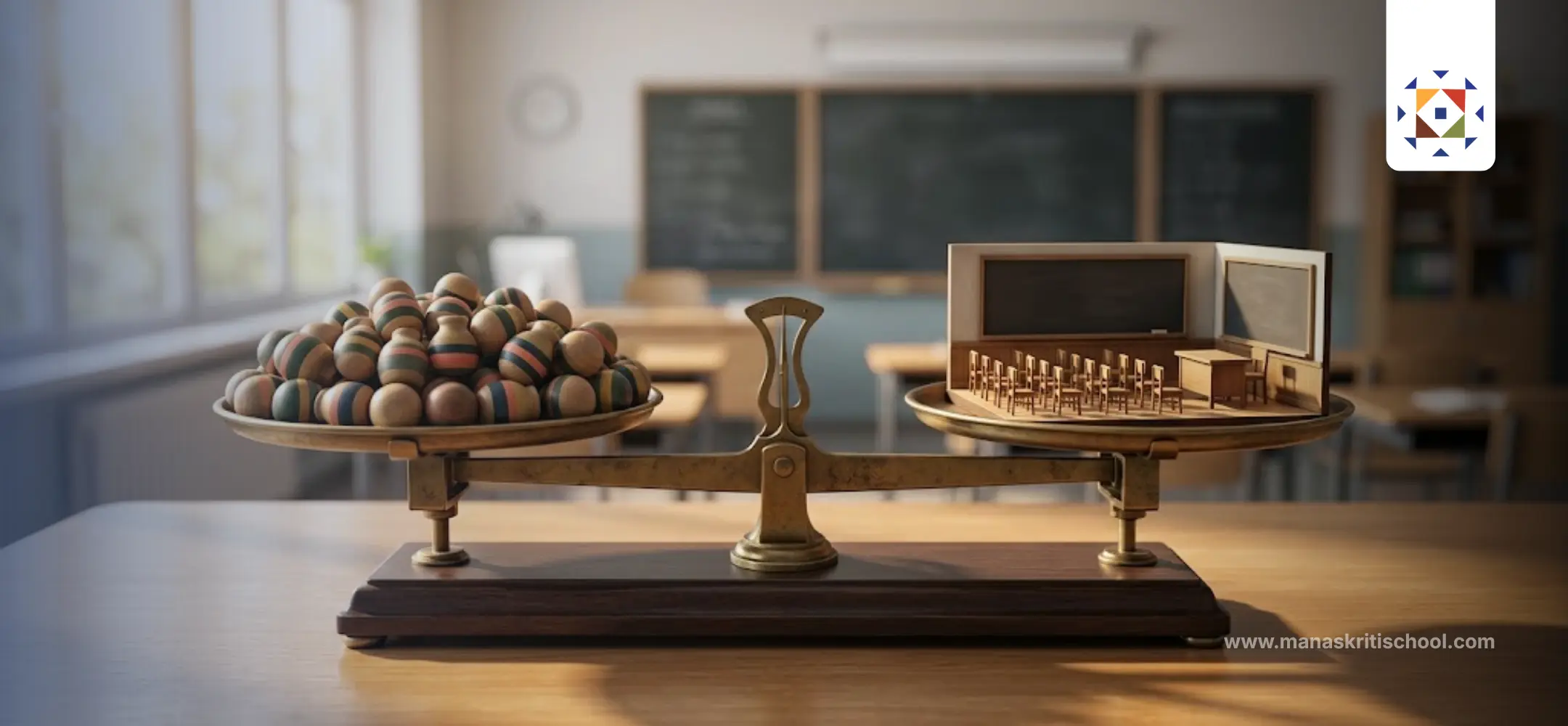
Teacher-student ratio and class size are not the same measurement. A school may report one teacher for every 30 students across the institution, while an individual child could study in a class containing more or fewer than 30 students.
What is teacher-student ratio?
Teacher-student ratio, also called pupil-teacher ratio, usually compares the total number of students with the total number of eligible teachers in a school.
For example, a school with 900 students and 30 eligible teachers has an overall ratio of 30 students for every teacher. This calculation does not necessarily describe the number of children sitting in one classroom.
What is class size?
Class size is the number of students assigned to a particular section or teaching group. It is closer to the everyday experience parents are usually trying to understand.
Class size can also vary by grade, subject and activity. A regular section, language group, laboratory session and sports period may all contain different numbers of students.
Four measurements parents should distinguish
| Measurement | What it means | Why it matters |
|---|---|---|
| School-wide ratio | Total students compared with eligible teachers | Shows broad staffing capacity |
| Section size | Students enrolled in one class section | Affects the everyday classroom experience |
| Adults in the room | Teachers or assistants present during a lesson | Especially relevant in early years and practical work |
| Contact and support time | How frequently a teacher reviews and responds to individual progress | Reveals whether attention becomes meaningful support |
What do CBSE affiliation rules say?
Current CBSE Affiliation Bye-Laws state that the school-wide pupil-teacher ratio should not exceed 30:1. They also describe a staffing provision of 1.5 teachers per section, excluding the principal, physical education teacher and counsellor.
These requirements help parents understand institutional staffing, but they still do not reveal the exact number of students in their child’s proposed section. That number should be asked separately.
Does a smaller class always mean better teaching?
No single number can guarantee learning quality. A smaller class may make observation and feedback easier, but outcomes also depend on teacher expertise, lesson planning, classroom routines, assessment and the support available when students struggle.
A well-managed class can be active and productive. A smaller class can still be ineffective if teaching relies only on copying and memorisation.
What should parents investigate?
1. The actual section size
Ask for the usual and maximum number of students in the grade and section under consideration. If sections are still being formed, ask when the final allocation will be known.
2. Teacher availability
Ask whether subject teachers, class teachers, assistants and learning-support professionals work with the section. Clarify which adults are regularly present and which visit only occasionally.
3. Attention during independent work
Find out how teachers review notebooks, listen to readers, observe practical work and follow up when a student has not understood.
4. Support during teacher absence
Ask how the school manages planned and unexpected absence. Frequent substitutions without continuity can affect learning even when the published ratio appears favourable.
5. Differences between grades
Early-years classrooms may require more support for routines and care. Older students may work with several subject teachers. One school-wide number cannot fully describe both situations.
Questions to ask the school
- How many students are usually enrolled in this grade’s sections?
- What is the maximum section size the school currently follows?
- How many adults are normally present in an early-years classroom?
- How often does a teacher review each student’s work individually?
- How are students grouped for languages, laboratories and activities?
- What support is available when a child falls behind?
- How are advanced learners given additional challenge?
- How are teacher absences managed?
- Does the published ratio include non-classroom teaching roles?
- Can parents observe an ordinary classroom routine?
A practical comparison table
| Question | School A | School B | School C |
|---|---|---|---|
| Usual section size | |||
| Maximum section size | |||
| Regular adults present | |||
| Learning-support process | |||
| Feedback frequency |
Understanding Manaskriti School’s published ratio
Manaskriti School’s website currently describes a 1:30 teacher-student ratio. Parents should ask how this number is calculated and then discuss the current section size for the relevant grade. This provides a more complete picture than relying on one published figure.
Frequently asked questions
Does a 30:1 ratio mean every classroom has 30 students?
No. It is commonly a school-wide calculation. The actual number in an individual section may differ.
Which number matters most?
Parents should consider section size, adult availability, teacher continuity and the process used to provide feedback and support.
Should parents choose the school with the smallest class?
Not automatically. Compare teaching quality, student support, culture, communication, commute and overall fit alongside class size.
Ask about your child’s proposed section
During your Manaskriti campus visit, discuss current section size, classroom support and how teachers monitor individual progress.